Tuesday, January 26, 2021

Mary Sophia Hill - Unsung Irish Civil War Hero

 In our first installment on the adventures of this brave Irish Nurse, we left her at the beginning of the war just after the battle of Bull Run.  


Mary Sophia Hill

She was horrified by the conditions the wounded soldiers had to endure long after the battle had ended, and describes her efforts to heal and comfort them.  She was still at a camp hospital a month after the battle and describes the situation: 

"Moved a mile further; ground for camping better, but water scarce and bad. General Ewell very much censured for not bringing up the reserve force into the battle at twelve o'clock, Sunday. Many lives would have been spared and many more prisoners taken; and if Beauregard had had cavalry to pursue to Washington, the war would have been ended, as the Northern troops were completely demoralised. The smell of the dead is awful in this camping-ground."


As she aided the wounded and sick of both sides things occasionally got out of hand - as she describes one occasion where the soldiers got their whiskey ration:

"As the men were so wet, an order was given for rations of whiskey. Consequences, nearly all were drunk and fighting. Ward-master and a little corporal went at it with bowie-knives, until I went in and separated them. Drunk as they were, they paid me the compliment of each giving up his knife when I demanded it. I had the doctor to put them under arrest until the whiskey evaporated. "    


Just under three months in service and she had earned the respect of the men she was treating as evidenced by that and also the kindness they showed her (which almost killed her!!)

"Men put a pretty arbor fence around my tent, which they shaded over; it looked very nice, and made the tent cool. And it was so kind of them to do it for me. But their kindness nearly killed me, as the structure was top-heavy; broke down while I was in bed, and nearly knocked the breath out of me. It was a fine moonlight night, and when I was able to scramble out, a good laugh set me all right, and my brother straightened up the tent. Next day my good friends made the structure less romantic but more substantial." 

A strong woman who  expressed  strong opinions in her diary on who was most fit to fight:

"Men raised in the country do not make hardy soldiers; those who knock round cities and towns are best, and can stand more fatigue and hardship, and the palm may be given for toughness to the Irish".


She encountered many of the famous personalities of the war, though left few thoughts other than the notations - "saw Stonewall Jackson riding through camp".   But one of the more detailed ones sticks out and gives another side to a famous Confederate Cavalryman:

"Gen. Stuart, what an indefatigable officer, nearly ubiquitous. I have met him everywhere, seen him with his command, travelling in the cars, amusing himself with children he seemed to love; I have also seen him in Richmond carrying a little school-girl's bag."


After nearly a year serving as a nurse she  began to long to return to her homes - her adopted home of New Orleans and her home in Ireland.   

We'll conclude her story next month as she takes her journey, her arrest as a spy,  and her strong opinions on the Irish involvement in the Civil War.  


Monday, December 28, 2020

The Irish Florence Nightingale of the South


The Irish Florence Nightingale of the South


Mary Sophia Hill, born in Dublin in 1819, is one of the many whose contributions were left in the fog of history.   Fortunately, she left a diary and other records of her story during and after the Civil War years, and it tells a fascinating tale. 


She came to America in 1850 with her brother and settled in New Orleans.   There she began a life as a teacher of Music and English.   Her diary starts just as the war broke out.   Her brother Samuel enlisted and became a private with the 6th Louisiana,  a regiment composed largely of Irishmen.


Some of her first thoughts:

In my eyes, the only blot I ever saw in the sunny South was slavery; but as a stranger, an alien, I had no right to meddle".

"How well do I remember all the excitement attendant upon the State of Louisiana seceding from the Union!  Ay, as well as if it were to-day; though little dreaming at the time I should have been in any way mixed up in the trouble that followed."


And mixed up in it she was,  deciding to follow her brother's unit as it moved north, and volunteer her services, where she was to experience the First Battle of Bull Run. 


As she describes in her diary - "I concluded I would follow him to Virginia to care for him … and that I would, wherever needed, care for the wounded, the sick, and the distressed.”


While her brothers regiment did not see action at Bull Run, Mary saw plenty - in the field hospitals and around the camps.  


Before the battle Mary described one of her first encounters with the troops while she was setting up the hospital. 


"When the exercises had concluded, the officers rode up to the hospital, and asked, had we anything to give them to drink? Major James was spokesman. I promptly answered yes, and handed him a bottle marked Old Cognac, which had been sent up that day with hospital supplies. The gallant Major handed it around, each taking a drink, some more, some less; of course they finished it, and rode off. Next morning when Dr. McKelvy came his rounds to the hospital, I was surprised to see a merry twinkle in the heretofore steady old gentleman's eye when he looked at me, and an explosion of laughter when, upon asking me what I had given the officers to drink the evening before, I said a bottle of brandy which had come with the medical stores. "Why," he replied, "it was cough mixture I sent in a brandy bottle, and you could have seen this in pencil-mark under Old Cognac." The principal ingredient of the mixture was tartar-emetic. Of course all who drank of it were dreadfully sick, and at first the doctor thought they were poisoned, until he heard of the drink at the hospital, when he as well as the officers felt sure it was a practical joke of mine, and were very wroth against me. Some time after I brought some good brandy, and offered it to my friends. All, like gentlemen, partook, to bury the hatchet, except my old friend Captain Monaghan, afterward Colonel, who could not be tempted. "No, Madam, I have taken my first and last drink in a hospital." 


A few days latter the Battle of Bull Run began.  She describes her experience:


"21st of June. Battle of Manassas began at half-past seven in the morning. Day very hot. Fighting all day.
  22nd. Sunday. Plenty of prisoners taken and Sherman's whole battery captured; I saw it with my own eyes. Water very scarce; troops suffered awfully for want of it. When Johnston's men came in the morning, at their halt at Manassas, I sent them buckets of water and a bag of crackers, that they might not face their enemy black fasting. Spent day at hospital with Dr. Nott of Mobile, and Dr. Williams. Tied up and staunched the bleeding of many a poor fellow. I remember being asked by some to pick Minie balls out of their legs and arms, while they waited their turn of the doctors, who of course had to attend to the most serious cases first. They have not half supplies. I tore down all the window blinds, and rolled them into bandages; nor was there half hospital accommodations. I made good chicken-soup, and flew around generally. The sights of the wounded were fearful to look at."


She describes more of the incidents surrounding the hospital and caring for the wounded - including one where a sutler (merchant selling goods to soldiers) was selling water at outrageous prices to wounded soldiers.  It led to this observation -  "If I lived a hundred years I would never forget that day, when I saw human nature in all its noblest and all its meanest attributes."


More of this amazing woman's story next month - a trip back to Dublin, and more writings from the battlefields and beyond.  

Sunday, November 22, 2020

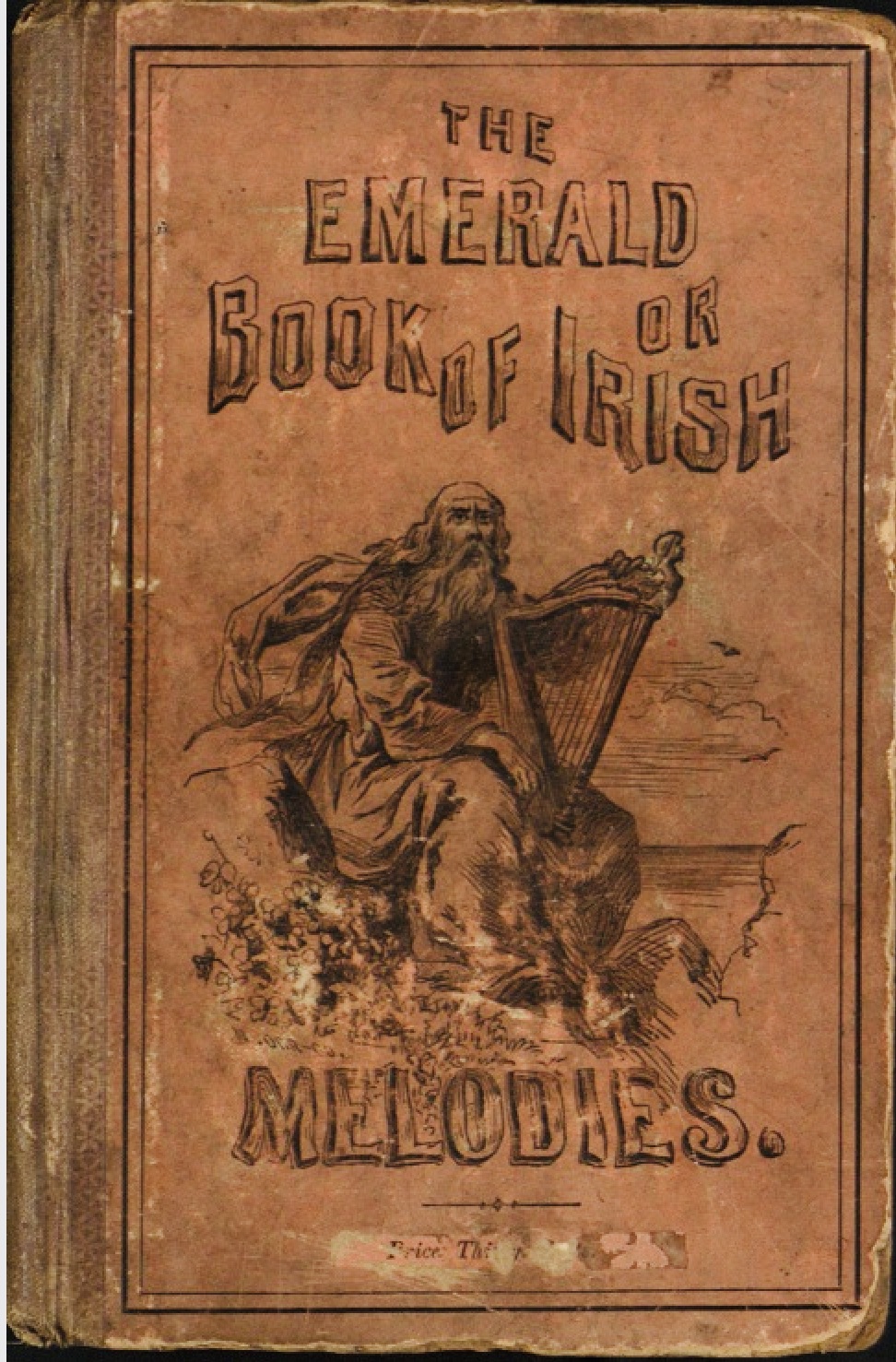
The Emerald - Irish Songs of the Civil War Part 2

Perhaps the  most requested  thing  Civil War soldiers asked for in their letters home  were  "Songsters" - small pocket sized books that featured the lyrics of  popular songs of the day (and only the lyrics - there was no written music in the songsters). 


I recently attended a lecture/zoom presentation by Dr. Catherine Bateson on the Irish Music of the civil war.    In her  research she estimated that over 200 Irish Songs were published during the war years (and possibly many more) out of the over 11,000 pieces of sheet music that were produced during the conflict.


During the Zoom presentation I had asked if she was aware of any songsters that specifically were for the Irish and featured Irish Music,  but she was unable to answer due to many questions and time constraints.   But a fellow attendee directed me to one that he was aware of - "The  Emerald Book of Irish Melodies."   


Published in 1863 by Dick and Fitzgerald of New York and sold for only thirty cents a copy it was readily available to the public and the soldiers of the North.     There is no listed author so likely the publisher collected many popular songs of the day.   

The book contains over 100 songs -  the  "Sentimental, Comic, Convivial, Political, and Patriotic songs of Erinia".    It's divided into two sections, with the comic songs taking up the entirety of part 2.    Some of the songs tell what tune goes with the song,  but most don't - leaving it to the singer to use popular tunes of the day as the melody.  Melodies from traditional Irish songs such as "Roisin the Bow" and "The Irish Jaunting Car" were used in many of the songs of the time.  

The book also contained over 30 pages of ad's for other songsters and books published by Dick and Fitzgerald.   There were  a few other Irish themed songsters advertised - " The Charles O'Malley Irish Songster", "Fred Mays Comic Irish Songster", and "The Frisky Irish Songster" are a few examples.    

There were also ads for Songsters by the popular Minstrels of the day - Christy's, Billy Birch's, and Bryants - as well as one for "The Little Mac Songster" to cash in on the popularity of General George McClellan among the Union Soldiers - he was also a favorite of the members of the Irish Brigade.   


General George McClellan 


The book titles advertised present  some interesting slices of 1860's  everyday life.    Some of the titles that caught my eye - "The Manufacture of Liquors, Wine, and Cordials",   "The Daring Deeds of Good and Bad Women"  (wish I could find that one) ,   "The Hangman of Newgate",  "Barney Riordan, or the Adventures of a Bashful Irishman",  "The Perfect Gentleman",  "The Ladies Manual of Fancy Work",  "Courtship Made Easy" and what I'm sure was a classic "Blunders in Behavior Corrected" (bet this would be useful by today's politicians).    Most of these could be ordered by mail for less than a dollar a copy.

But back to the songs - a treasure trove  with traditional classics like "Molly Bawn", "The Exile of Erin", "Kathleen Mavourneen", and "The Irish Jaunting Car" - along with many long forgotten songs like "The Land of Potatoes", "Dorans Ass",  and "The Wake of Teddy the Tiller".   


It will take a while to read them all -  which will keep me busy during the pandemic - and I may perhaps add a tune to a few to try and revive them.

In  many of the forgotten songs I found some golden nuggets of verse - here's one of my favorites from the song "Good Morrow to your Nightcap".  ( A  precursor to the session tune of similar name?)

Last Night, A Little Bowsy
With Whisky, Ale, and Cider
I asked young Betty Blowsy
To let me sit beside her

Her anger rose, as sour as sloes*
The little gipsy cocked her nose
So here I rid away to bid
Good morrow to your Nightcap

*Sloes are the bitter fruit of the blackthorn and used to make Sloe Gin 


Tuesday, October 27, 2020


Civil War Songs and the Irish

Part 1


“These Days will be remembered by America’s loyal sons,

If it hadn’t been for Irishmen, what would your Union done?

Hand to hand we fought them, out in the blazing sun

Stripped to the pants we did advance, at the Battle of Bull Run”


Prior to the first shots of the Civil War, the Irish in America were a favorite butt of many a joke that poked fun at them as an inferior race.   “Paddy” and “Mick” were pictured in song as lazy, stupid, drunken idiots from many stage performers and examples of this abound in the sheet music of the 1850’s - the era of "No Irish Need Apply".       


The above song, a folk verse from the 1860’s,  shows that the tide was turning in the culture.  This music of the Civil War featuring  the Irish Brigade and the Fighting 69th would play a big part in  making these stereotypes diminish and eventually disappear.


Dr. Catherine Bateson has done extensive studies on the music of the Civil War that featured the Irish.   Her graduate thesis focused on the  sentiments of Irish American Civil War songs and music. She studied the way in which Irish singing culture influenced American musical culture in the mid-nineteenth century and how song was used to express the wartime experiences of the Irish diaspora in America.


It was interesting to learn from her work that there were over 100 songs written during the war that featured the Irish Brigade, the 69th, or its famous Generals Michael Corcoran and Thomas Meagher.    


Dr. Bateson also speculated that this music from the Civil War is how Irish Music became “Americanized” much in the same way that the war experience of the Irish was critical to their assimilation into American Society   Take the “Gallant Sons of Erin” - one of the first of the era to show the Irish as brave:


“You, Soldiers brave, pray pay attention: gentle folks, grand condescention,

While in this song I will make mention of the sons of Erin;

Whose brave behavior do excel what pen can write or tongue can tell

The Sixty-Ninth, you know well, are gallant sons of Erin.


"Gallant Sons of Erin" goes on to give a fairly accurate account of the history of the 69th and features its famous leader Michael Corcoran.  This is one of many in this canon of music written during the war – others of note include “Pat Murphy of the Irish Brigade”,  “Corcoran’s Ball”,  “The Irish Volunteer”,  “The Boys of the Irish Brigade” , “The War Song of the 69th” (Sheet cover shown above),  and the “Battle of Bull Run”.   


Music was the CNN of the day in the 1800’s as the stages of all the major cities featured many types of performances.    Minstrels were in their heyday, but many singers and groups like the Hutchinson Family also attracted large audiences to the music halls.     They sang topical songs of the day that told stories of the war and those fighting it.     Music of the war was quite popular.   


The power of song also made these messages memorable and helped to form the opinions of the listeners.   Plus, the wide distribution of sheet music put these songs into the homes of thousands of Northern families where  nightly entertainments featuring song were common.   


These songs portrayed  the Irish as brave soldiers -  loyal to the Union cause and willing to make the ultimate sacrifice to preserve the Union.    They certainly had the  effect of changing the  perception and acceptance of the Irish by the American people.


Perhaps the best example of the attitude towards the Irish coming full circle was a song performed by a popular singer of the day - Joe English (a pause for irony).   He wrote the song “Paddy and the No-Nothings” that featured this verse:


“The President called on the land for an Army,

And straightway to arms each patriot flew

And they found that the men that they had scorned and slighted

The Irish Brigade to the Union was true”


Friday, September 25, 2020

Michael Corcoran - Irish American Hero


Colonel Michael Corcoran, commander of the Fighting 69th at the First Battle of Bull Run,  was well known and highly regarded by the Irish of NY.     He was a member of the Fenian Brotherhood, and hoped his military experience in the war would help later in Ireland's fight for freedom .    His actions at Bull Run, protecting the retreat of the Union Army, were praised by the NY Newspapers.    But he became one of  the first prisoners of war in the conflict. 


He kept a journal of his year in captivity, which is a very revealing account of not only his experience, but of the lives and experiences of those he encountered.   His account, “The Captivity of General Corcoran” was published in 1862 shortly after his release. 


His valor at Bull Run was documented by a member of the 69th, David Power Conyngham, who published a book shortly after the war “The Irish Brigade and It’s Campaigns”   In it he describes how Corcoran rallied the 69th while the most of the Union Army had panicked and was retreating.    His decision to stand firm protected the retreat and may have saved the life of many a Union Soldier.   


Conyngham writes “Colonel Corcoran formed the remnant of his forces into a kind of square to meet a charge of cavalry, which they repulsed.    As they gained the road they were again charged on, and Colonel Corcoran was wounded through the leg.   Colonel Corcoran was everywhere conspicuous, cheering on and rallying the troops; even when wounded he checked the rebel advance with his little band, and disdained to leave the field until he was captured at his post of honor.”


Corcoran's book starts with the transfer of the 600 captives from the battlefield to Richmond.   He was well aware that the Confederates had no idea what to do with the prisoners.   Many of the soldiers thought they would be torn apart by mobs of angry rebels.   That was not the case.   They were kept in a tobacco warehouse and became a curiosity to the citizens of Richmond as he describes  “Many distinguished persons of Southern birth and proclivities visited our quarters, and behaved, as a general rule, in the best manner…”


Of their captors Corcoran states  “We were provided with refreshments by the Major in charge, to whom, for his considerate care and attention to our wants, we felt it to be our duty as well as pleasure to pass a vote of thanks.”


When they were settled in Richmond, they were allowed to form "The Richmond Prison Association, whose purpose was to help them kill the time.     He notes - “We debated, sang, told stories, played cards, …. leaped ran races, wrestled and in short, were most successful in accomplishing our object.”


They were allowed to read Northern Newspapers, and Corcoran was amused to read that he had been placed in irons for refusing to answer roll call.    He writes “Not only was this entirely untrue, but there never was the slightest foundation for it.”


Corcoran was transferred to Charleston, and on the way nearly killed by a citizen who he had been arguing with on the Railroad platform, but was saved by a young lady who stepped between them long enough for the guards to intercede and remove his assailant.  The incident made  a great  illustrations in his book.


While in Charleston prison, Corcoran describes how they used music to keep up their morale and provoke their captors.   It became very common for both sides to weaponize their music like this during the war, and this may have been one of the first times it happened.  


 Corcoran writes:


“At 4 o'clock P. M. , we had a concert among ourselves , at which we were honored by the audience of several Confederate officers , who seemed highly delighted with the performance , until , in grand strains , we gave them “ Hail Columbia . ”   At this their countenances rather fell , and they seemed to wish themselves away.   Desiring to give them a full dose of Union melody , we immediately, upon the conclusion of the song , struck up , “ Columbia , the Gem of the Ocean." 


“This forced one or two of them to excuse themselves very suddenly on important duties , and , by the time that we got to the middle verse of “ The Star Spangled Banner , ” only a solitary one of them remained ; and I had heard hints thrown out that he was not thought to be fully loyal to the rebel government .   Thus his desire to listen to the good old song was accounted for .    I have often heard of Satan getting into agony when the sound of a church - bell struck upon his ear ; but I doubt if the old gentleman ever feared the ringing of a church - bell worse than a rebel fears the stirring notes of “ The Star Spangled Banner . ”


During his imprisonment, Rebel Privateers of the ship Savannah were captured, and sentenced to be hung for piracy.   In retaliation, the Confederate government advised that they would hang and equal number of Union prisoners of war.    The Rebels  felt the Savannah was engaged in war, not piracy.   Lots were drawn in prison, and Corcoran was one of the unlucky ones to receive the death sentence.    Fortunately for him both sides backed off and he was released in a prisoner exchange, which was common in the early years of the war.


Anxious to resume the fight, Corcoran gave up a lucrative position as Harbormaster of NY Harbor to rejoin the 69th.     He returned to cheering crowds in New York City and started recruiting for the brigade that would be known as Corcoran’s Irish Legion.


He would not live to see the end of the war.    He went for a ride to check picket lines on a horse borrowed from his friend, Thomas Francis Meagher.   The horse suddenly got startled and he was thrown off.   He was a skilled horseman, but he had been feeling unwell for several days.      Corcoran fractured his skull and died at the age of 36 on December 22nd.    


Conyngham, in his history of the Brigade, wrote on the passing of Corcoran: 


“Thus died, in the prime of manhood, as brave a soldier and as sterling an Irishman as ever lived. He was a loss to America, for his name and reputation were talismanic to collect his countryman to his standard. "

"He was a loss to Ireland, for the dearest wish of his heart was to live to strike for her independence; and from his experience as a soldier, his wisdom as a general, and his prudence and foresight as a man, who knows what he would have accomplished had he lived?”


Wednesday, August 19, 2020

Michael Corcoran - the First Commander of the Fighting 69th and his song

 A recent book by Timothy Egan on Thomas Francis Meagher (which is an excellent read btw) was titled "The Immortal Irishman".   If the title were not already used, I would have titled this article, and a few to follow on Michael Corcoran the same.   If not for a freak accident which killed him in 1863, he might have been the most well known and beloved of all the Irish who fought for the Union Army.   


Corcoran was born in Carrowkeel, Ballymote - son of an officer in the British Army married to an Irishwoman. At the age of 19, he joined the revenue police in Donegal where his job was to bust illegal poitín stills.  While in Tir Conaill he joined the Ribbonmen - a secret society dedicated to protecting Catholic and tenant rights.  In 1849, Corcoran may have been forced to leave  Ireland because of his involvement in that secret society.   He  sailed for America, and got a job as a clerk in Hibernian House, in New York City,  and married the owner's niece, Mary Heaney. 

Corcoran was instrumental in the founding of the Fenian Brotherhood in the US in the 1850's, and his interest in forming the 69th NY Militia rose from his strong political beliefs. He and many other members of the Brotherhood believed that by forming Militia groups in the US, they were  aiding Ireland in its fight for freedom.   

During these times the Brotherhood in Ireland was very close to the Fenians in the US.  They thought that their objective, a free Irish State, would be accomplished by developing  a strong military presence in the US that could ultimately be used against England.  It's interesting to speculate how the Fenian Raids of 1866 and beyond would have turned out if a seasoned and sensible commander like Corcoran had survived the Civil War.  

Corcoran was the first commander of the 69th, and  achieved fame in the Irish Community in NY and throughout the US for his refusal to allow the 69th to march in a parade honoring the visiting Prince of Wales.  “Although I am a citizen of America, I am a native of Ireland,” Corcoran said. “In the Prince of Wales I recognize the representative of my country’s oppressors.”   

When the first shots were fired at Fort Sumter, he was under Court martial.   His indiscretion was quickly forgiven as Lincoln called for soldiers to fight the war, and the 69th was eager to put an end to the Southern insurrection to show their loyalty to the US and their military prowess.    He proudly led the 69th as they marched down Broadway on their way to Washington to join the fray, cheered on by thousands, marching to traditional Irish tunes such as the Minstrel Boy.

Corcoran was captured at the First Battle of Bull Run, and during his capture he kept a journal of his imprisonment.   It was published in 1862,  It's an interesting read, and considering he was under an order of execution, amazing that he could keep a journal.   He was held for a year, and released in a prisoner exchange.   

Because of his celebrity, he was the topic of news and speculation as the folks  in NY City were very interested in hearing of his imprisonment and well-being.   So naturally a song was written and published during those times.  (I have yet to find the name of the author)  This was to be sung to the tune "The Union Cockade".  Enjoy.


                   Richmond Jail

     (Dedicated to Michael Corcoran of the Irish Brigade.)

This southern rebellion has raised a mighty fuss,

And before it ends I fear it will make things a great deal worse,

With Stonewall Jackson at their head they threaten us to whale,

And every man they take from us to lodge in Richmond Jail.


Chorus: come boys, come I know you ain't afraid,

We'll go down to rebeldom with Corcoran's Brigade.


That traitor old Jeff Davis thinks that we are near whipped,

But we'll show him that like Lawrence we will not give up the ship,

John Bull with intervention thinks our gallant boys to scare,

But he'll soon find out we can't be beat or sent to Richmond Jail. 


Chorus


Foremost among all others the 69th did go,

To meet their southern foemen in response to Lincolns call,

The gallant Corcoran at their head as they marched down Broadway,

Not thinking then how soon he'd be locked up in Richmond Jail. 


Chorus


That ever memorable day of the battle of Bull Run,

Bold Corcoran was in the field and showed the rebels fun,

Protecting our army's rear mid cannonball like hail,

Twas then that he was taken boys and lodged in Richmond Jail.


Chorus


It was while this in bondage they offered him parole,

But he nobly did refuse it saying I would not sell my soul,

Your parole of honor you may keep I'd rather much remain,

Yes and rather die than take it to get out of Richmond Jail.


Chorus


At length, the glorious day came on which he did return,

And many a gallant Irish heart with noble ardour burned,

They flew unto his standard and swore they would not fail,

To avenge his foul imprisonment way down in Richmond Jail.


Chorus


Soon this gallant Irish corps to rebeldom will go,

To confront with man and musket Stonewall Jackson's rabid horde,

At the point of the bayonet for which they are so famed,

Once more he'll go to Richmond boys but not to Richmond Jail.


Chorus


Then give me your attention I'm about to end my song,

The few words I've to say to you will not detain you long,

When next they meet our Corcoran the rebels raid will quail,

And skedaddle back to Richmond from that man of Richmond Jail.  


In next months article we'll take a look inside his journal and share his thoughts, observations, and insights - and the ironic circumstances of his untimely end.  


Monday, August 17, 2020

Father William Corby - the Fighting Irish Priest

One of the more interesting Irishmen who served in the Civil War was Father William Corby. Corby’s father Daniel emigrated from County Offaly in the early 1800s. Father Corby was a priest at Notre Dame University when the war broke out. He describes his decision to volunteer his services to the Irish Brigade as a result of his patriotic zeal and his desire “to give salvation to those destined to fall” in battle. In his book Memoirs of Chaplain Life he describes his feelings as he took a train from Chicago to New York to meet the soldiers he would serve with, “It was much like getting married. We made the engagement for better or worse, for richer or poorer, till death do us part.”

At that time Father Corby did not know how many partings he would endure, how many dying men he would comfort, or how many wounded he would tend to. His book is one of the best first-person accounts of the everyday life of the soldiers in the Civil War that I have read. He knew some of the great personalities of the era, as well as hundreds of common soldiers.

Although he served in the 88th regiment, he was quite impressed with another regiment of the Irish Brigade, the Fighting 69th. His description of Thomas Francis Meagher, commander of the 69th – “He had a superior intellect, a liberal education, was a fine classical writer, and a born orator. He was very witty but more inclined to humor; was fond of witty or humorous persons and admired those who possessed those gifts. He was a great lover of his native land, and passionately opposed to its enemies; strong in his faith, which he never concealed, but on the contrary, published it above board; and where ever he went he made himself known as a Catholic and an Irishman”.

In the 1860s in America, it was a bold position to take as discrimination raged against both Irish and Catholics. Corby also met personally with President Lincoln during the war. He was asked by the soldiers to plead for clemency for a popular member of the regiment who was court-martialed for abandoning his post, getting drunk, and committing a serious crime. The soldier was sentenced to death. He describes approaching the White House – “I felt like a fresh blushing Lieutenant”. He writes that Lincoln was “a very tender-hearted man” and he told the president he was leaving the man’s life in his hands. Lincoln responded, “Chaplain see here! I will pardon him if General Meade will.” Unfortunately, the generals in the field felt Lincoln was too kindhearted in pardoning so many, and Meade refused to overturn the court-martial. When Father Corby returned to camp, he gave communion to the condemned man and comforted him up to the time of his execution.

Corby is probably most famous for his giving absolution to the Irish Brigade before they entered the battle of Gettysburg, and there is a statue there of him in the spot where it occurred. From Colonel St. Clair Mulholland – “There are yet a few minutes to spare and the time is occupied by one of the most impressive religious ceremonies I have ever witnessed. The Irish Brigade stood in a column of regiments, closed in Mass. The chaplain of the brigade, Rev. William Corby, proposed to give a general absolution to all the men before going into the fight. This was perhaps the first time it was ever witnessed on this Continent. Father Corby stood on a large rock in front of the brigade. He explained that each one could receive the benefit of absolution by making a sincere act of contrition and firmly resolving to embrace the first opportunity to confess his sins. As he closed his address every man, Catholic and non-Catholic fell on his knees as Father Corby pronounced the words of absolution.”

As this was occurring the soldiers could hear the sounds of the nearby battle as it raged close by. Corby intended the absolution to cover all the fighting men, north and south. He knew many of those who were kneeling before him were soon to die or suffer serious wounds on the battlefield. He had been with the brigade when it was 3,000 strong and at Gettysburg the unit was down to 530 men. Of the men in the brigade Father Corby absolved that day, 27 were killed, 109 were wounded, and 62 were listed as missing.

Father Corby’s recollections were famous and appear in many historical accounts of the Civil War, past and present. After the war, Corby returned to Notre Dame where he served two terms as its president. During his tenure, the school grew, admitted more students, and added the School of Law. It may also be that the name the “Fighting Irish” came about because of the priest who served as chaplain of the Irish Brigade. 


His Gettysburg statue was duplicated for Notre Dame University and is located outside Corby Hall.    There the football crazy students have been known to call him “fair catch Corby”.


Christmas with Irish Brigade (and a few other stories)

Harpers Weekly Christmas 1863 - Santa visiting a Union Camp Christmas was one of the few times during the Civil War that the common soldiers...